
A Cosmic Perspective
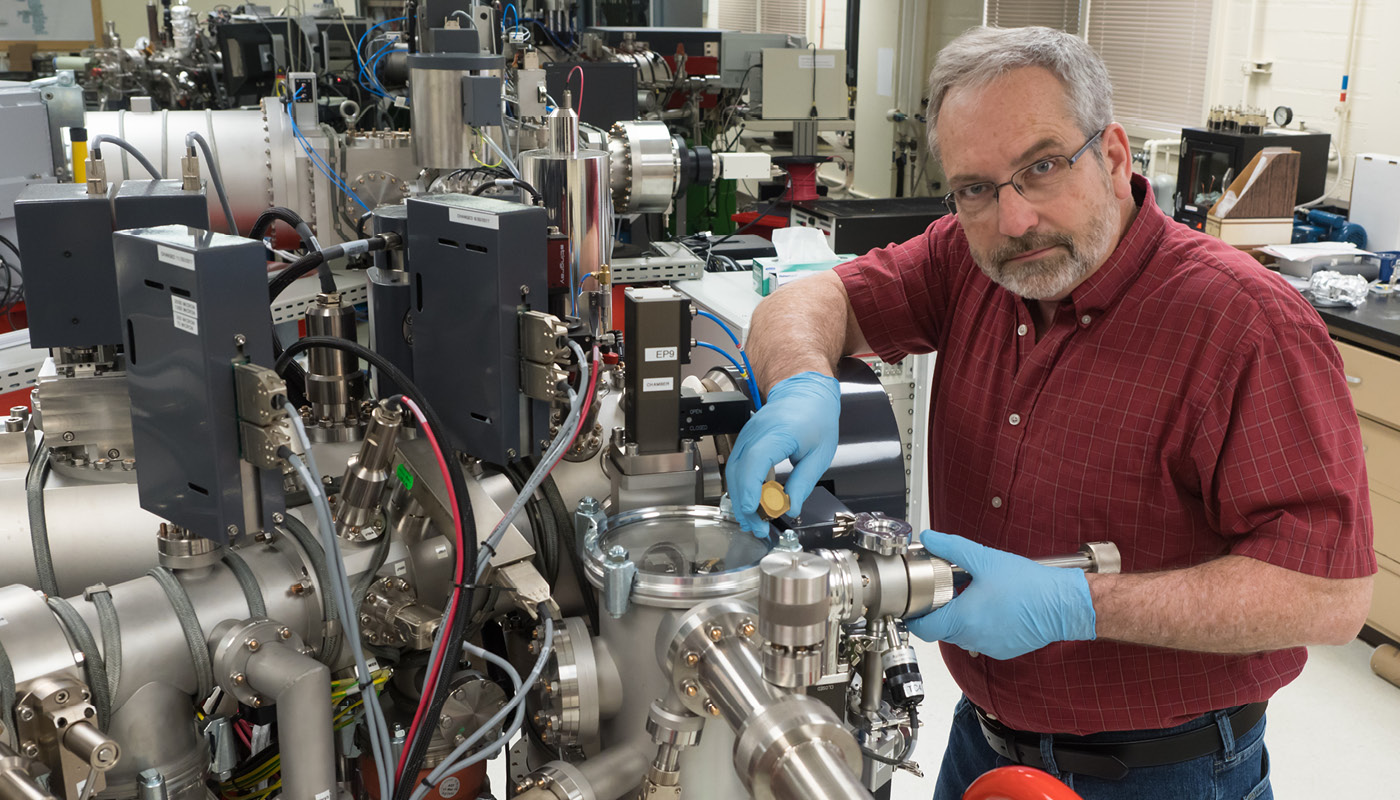
Kevin McKeegan 鈥�76 working in his lab, introducing a sample into the ion probe (mass spectrometer).
By Chris Connell 鈥�67
The scene unfolding on a big screen in an auditorium at the Jet Propulsion Laboratory in Pasadena, Calif., was like something out of a screwball space comedy: a capsule was barreling back to Earth after two years perched in a spacecraft a million miles away orbiting the Sun and catching solar wind samples on NASA鈥檚 $260 million Genesis mission. UCLA cosmochemist Kevin McKeegan 鈥�76 was standing on stage, ready to explain the importance of the experiments ahead. The capsule was to float down by parachute toward an Air Force bombing range in Utah, where a stunt pilot flying a helicopter with a long hook was poised to snag it midair. A NASA announcer was reading a prepared script when McKeegan noticed he could spot lettering on the capsule which supposedly was still 20 miles up. 鈥淢aybe the military has really good cameras I don鈥檛 know about,鈥� he thought.
Not quite. Five seconds later, the audience watched agape as the capsule slammed into the ground, scattering debris and the particle detectors across the desert floor. (Engineers would later diagnose the cause: a little part that was needed to deploy the parachute had been inserted backwards.) 鈥淎ll of a sudden these bored newspaper reporters got very alert because now they had a story,鈥� said McKeegan. 鈥淚 tried to put a good spin on it.鈥� The atoms of oxygen that Genesis had patiently collected would still be embedded in crystals of pure silicon carbide for McKeegan and his team to analyze in a novel mass spectrometer of his own design.
Indeed, while some samples were contaminated, others survived the 190 mph landing and made it into a NASA clean room. Seven years later, in 2011, the cover of Science proclaimed the discovery: the Sun鈥檚 oxygen was very different from that found on the Earth, the Moon, Mars or meteorites from the inner solar system, meaning the solar system鈥檚 gas and dust evolved before forming the rocky planets nearest the Sun. It was 鈥渁 big result,鈥� says McKeegan, and changes scientists鈥� thinking about the way that rocky planets form. The Genesis results remove any status of the Earth as somehow special in a cosmic perspective, in a way not dissimilar to what happened after Galileo and Copernicus disproved the belief that the Earth was the center of the universe.
For this work and more in a career finding new ways to micro-analyze extraterrestrial materials, the National Academies of Sciences, Engineering, and Medicine in April awarded the 2018 J. Lawrence Smith Medal to McKeegan, a triennial honor that comes with a $50,000 prize for a lifetime of work that might not have happened had he followed his initial instinct after 麻豆视频.
鈥淚t wasn鈥檛 like I felt I was destined to be a scientist,鈥� says McKeegan, the eldest of six children, born in Flushing and raised in Queens Village. 鈥淚 liked literature and going into St. Lawrence University I thought maybe I鈥檇 be a novelist.鈥� But he gave physics a try 鈥渁nd it turned out I liked physics and was good at it.鈥� Ironically, he鈥檇 eschewed the science track at 麻豆视频 for languages on the advice of his father, a policeman. 鈥淭here are 2 million people in the city of New York that speak Spanish. You should learn Spanish,鈥� his father told him. But he took biology and chemistry taught by a new faculty member, Miss Otto (Walsh) and also an astronomy class from Father Egan, SJ, before heading upstate to St. Lawrence with three classmates.
As an 8th grader at Sts. Joachim and Anne School in Queens Village, McKeegan had never heard of 麻豆视频 until the principal called him, Robert Franco 鈥�76 (his classmate from kindergarten through college and later himself a Ph.D. biologist) and another boy to the office. 鈥淪ister said, 鈥榊ou鈥檙e going to take this test for this school called 麻豆视频 in the city,鈥欌�� he says. He took the test and was called back for an interview and then his parents were summoned for an interview as well. 鈥淭hey hit it off with Father Fitzpatrick and were quite impressed,鈥� he says. McKeegan ran track, adding subway trips to the Bronx to an already long commute. 鈥淚 have extremely fond memories of 麻豆视频. In terms of the education I got and the people I met, I think it was basically life-defining,鈥� he says.
At Washington University in St. Louis, he won an 鈥渁stronaut fellowship鈥� endowed by the founder of McDonald-Douglas and named for Roger Chaffee, one of the three astronauts who perished in a fire on the launch pad in 1967 on the first manned Apollo mission. After earning his doctorate in physics in 1987, McKeegan did a post-doc at the Lawrence Livermore Lab in the Bay area researching what to do with nuclear waste. 鈥淚 was going to help solve the nation鈥檚 nuclear waste problem. After 1陆 years, I realized it was more of a political problem than a scientific one.鈥� He joined a UCLA research lab in 1991 and later the teaching faculty after Stanford had tried to lure him away.
Genesis was launched as part of NASA鈥檚 Discovery program, which funds relatively low-cost projects conceived and carried out by academic teams, not government scientists. The team led by a Cal Tech geochemist first sought funding in 1994 but was turned down when they called the mission Seuss-Urey. But they got a green light when they gave it the snappier name Genesis.
McKeegan, 60, and wife Grace鈥攁 college classmate鈥攈ave a son and two daughters and recently became grandparents. He teaches UCLA undergraduates and graduate students and runs two big labs equipped with million-dollar mass spectrometers and funded by NASA and the National Science Foundation. While no plan is in the works yet for a follow-up to Genesis, there鈥檚 a proposal for a new mission to try to gather samples from the nucleus of a comet beyond the asteroid belt which would 鈥渉elp us really understand the full distribution of elements in the solar system,鈥� says McKeegan. But it takes a long time to go to the outer solar system and come back, possibly not until the late 2030s which 鈥渕ay be beyond my career,鈥� he says. Still 鈥渋t鈥檚 kind of a nice feeling that you鈥檙e part of this continuum of science.鈥�
And for the next mission, they鈥檒l no doubt make sure this time that parachute 鈥淕-switch鈥� isn鈥檛 put in backwards.
Read more 麻豆视频 news