
Regians Gather for Ascension Thursday Mass
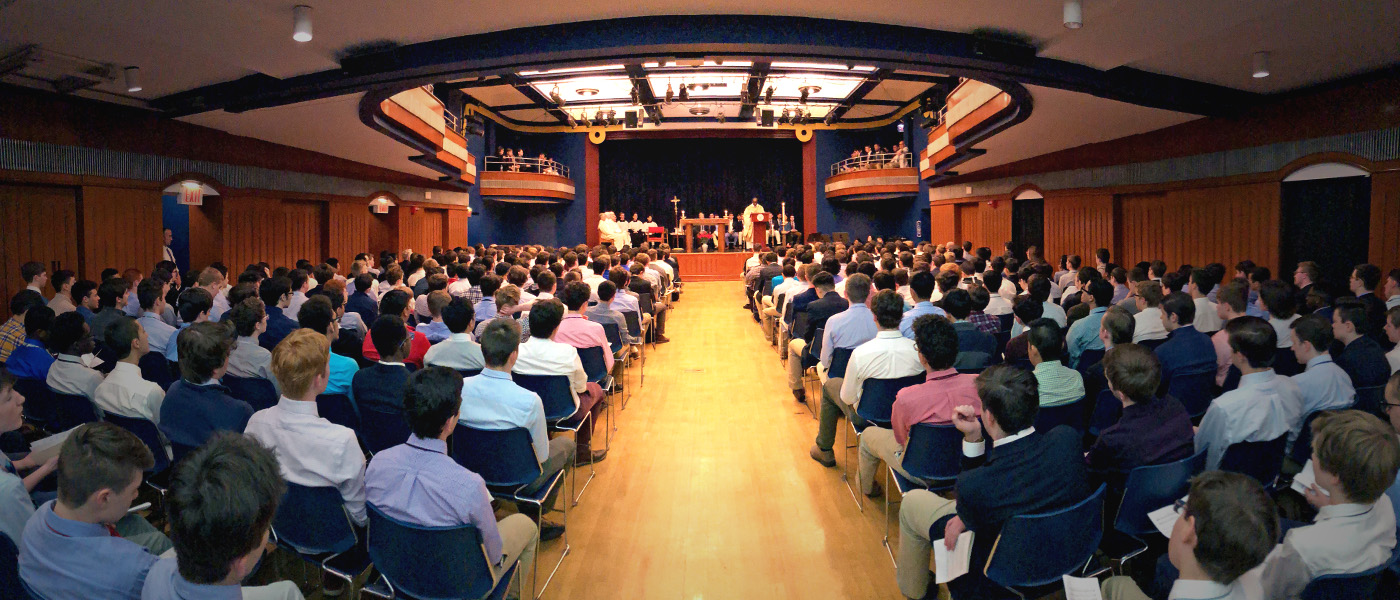
On Thursday, May 10, the 麻豆视频 High School community gathered in the Auditorium to celebrate Ascension Thursday. Below is a video and reprint of Fr. Mario Powell, SJ's homily delivered at the Mass.
Solemnity of Ascension: The Gospel Dream
The angels鈥� words to the 鈥渕en of Galilee鈥� in the first reading from the Acts of the Apostles for the Feast of the Ascension of the Lord are wonderfully blunt and leave little room for misinterpretation: 鈥淲hy do you stand here looking up at the skies? This Jesus who has been taken from you will return, just as you saw him go up to the heavens.鈥� Then there is one last bit of instruction. Don鈥檛 keep trying to stare into the future. Don鈥檛 be overly concerned about which hour he will come back. It鈥檚 as if our Lord is telling them that we must not just stand staring up idly into the heavens and moaning about our past or present state, but that we truly have get to work鈥攂ringing about the Kingdom of God. about the past, about which we can do nothing.
This celebration of Jesus鈥� Ascension is not a celebration of Jesus鈥� disappearance. He did not vanish or escape from earth. This is not Jesus telling us this world is so bad that I have to escape. In God, Jesus is 鈥渉ere鈥� in a new and very specific way. That way raises our hopes and calls out from us a better way of living with each other. Because, left to our own devices we often do not choose love and justice. Paul Bloom, a renowned psychology professor at Yale, bellies this concern saying:
I think a lot of real awful things we do to other people arise from the fact that we don't see them as people. But the argument is incomplete. A lot of the cruelty we do to one another, the real savage, rotten terrible things we do to one another, are in fact because we recognize the humanity of the other person.
We see other people as blameworthy, as morally responsible, as themselves cruel, as not giving us what we deserve, as taking more than they deserve. And so we treat them horribly precisely because we see them as moral human beings.
Put another way, the Solemnity of the Ascension begs out of us a heightened sense of love, hope, and an audacity of justice especially when we encounter the 鈥渙ther鈥� face to face.
The Ascension Gospel text for this year is taken from the conclusion of the Gospel of Mark. During his ministry, Jesus sent his disciples to preach, to heal, and to drive out unclean spirits. Now they are sent again to do these things and more. From his place with God in heaven, Jesus helped his disciples, and he continues to helps us as we try to live as his followers. Only the Gospel of Mark notes that Jesus ascended to sit at the right hand of God. In noting this, Mark teaches that Jesus鈥� ascension affirms the glory Jesus received from God after his death and Resurrection. With God Jesus ascends into glory.
鈥淲ith us here on Earth, Jesus is ridiculed, betrayed, arrested, flogged, and crucified. Just as the Risen Lord entrusted himself into the hands of such pathetic, broken people who were with him, he does the same to us. Our own brokenness and sinfulness are so overpowering at times that we forget that this incredible commissioning鈥攖hat God can indeed call us鈥攖hat God can draw straight with crooked lines. Jesus chooses not the perfect as his disciples, but the most human.鈥� But as Paul Bloom has posited, when we are at our most human鈥攚e are most capable of the most injustice towards one another.
The mysterious feast of Ascension reminds us that Christ accepts our lack of self-confidence in ourselves. He accepts the shadowy and dark areas of our humanity. He accepts our capacity for deceit, betrayal, greed and power. And having accepted us, he calls us, gives us the eternal commission to be his people, and sends us to serve him and love him, in spite of ourselves and because of ourselves. John Henry Cardinal Newman said it well long ago:
He calls us again and again, in order to justify us again and again鈥�
And again and again, and more and more鈥�
He calls us... in our brokenness... he calls us in our sinfulness. He calls us again and again, in order to justify us again and again. He calls us again and again, and again and again so that we don鈥檛 give in to the intoxicating attractiveness of the mediocre鈥攎ediocre expectations; mediocre hopes.
Benedict XVI in his encyclical Spe Salvi holds up the Sudanese slave turned religious sister, St. Josephine Bakhita as a model of hope. Benedict writes: 鈥淣ow she had 鈥榟ope鈥欌�攏o longer simply the modest hope of finding masters who would be less cruel, but the great hope: 鈥業 am definitively loved and whatever happens to me鈥擨 am awaited by this Love. And so my life is good.鈥� Through the knowledge of this hope she was 鈥榬edeemed,鈥� no longer a slave, but a free child of God.鈥�
Here Benedict wrote that love can free us from the prison of history as just one thing after another鈥攖his Marxian notion of history and injustice happening to us. He writes, 鈥淭o imagine ourselves outside the temporality that imprisons us, and in some way to sense that eternity is not an unending succession of days in the calendar, but something more like the supreme moment of satisfaction, in which totality embraces us and we embrace totality.鈥� We do not accept our world for what is and walk away from what it could be. We do not accept injustices in our midst, because they have been here for a time and they are hard to rid ourselves of them. Why? Well, because God seemed to take the trouble to become human, live with us, be exploited by us, and die for us. The least we can do in return is come face to face with this supreme satisfaction and look around our world and ask: are we indeed satisfied?
Our hope is for something more, something beyond this world and across the threshold of time and death, is not only a desire for a love beyond limits, but also a desire for a limit to evil, a desire for justice. Our hope demands the triumph of justice, which plainly does not prevail in this world. Put more colloquially:
Look, if you had one shot, one opportunity
To seize everything you ever wanted
One moment
Would you capture it or just let it slip?
What do we hope for: for life, for love, for mercy? Let the anthem of this Ascension be 鈥淭hy Kingdom Come,鈥� right here in the messiness of this earth and our own lives鈥攜es, they kingdom come. But our prayer is incomplete, because we don鈥檛 yet fully know even with all of our knowledge what the Kingdom of God ought to look like so we pray out of humility 鈥渢hy will be done on earth as it is in heaven.鈥� Let our hopes for each other be raised as Christ ascended. Let our dreams for how we live together be raised up and not scrape at the bottom of the barrel. Thy Kingdom Come, thy will be done.鈥� Let鈥檚 get going and carry a piece of heaven into the world.
麻豆视频 High School Auditorium
May 10, 2018
Read more 麻豆视频 news