
Crossing Borders: Seniors Connect with Syrian Refugee Students
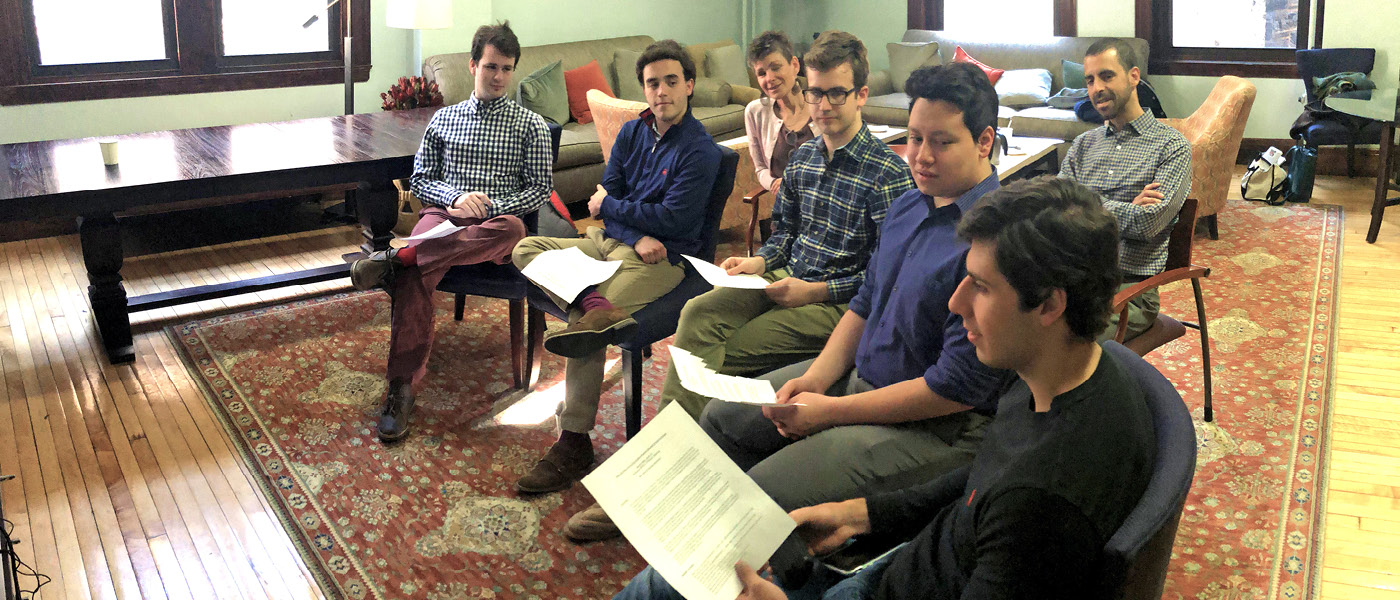
Mousa Adely 鈥�18 (far right) provided translation between Arabic and English during a video conference call with the Jesuit Refugee Services youth club in Beirut.
鈥淲here are you from?鈥� The question is asked more often at 麻豆视频 than other schools, with answers ranging from 鈥渁round the corner鈥� to 鈥渢he next state over.鈥� But when a group of seniors posed it at the beginning of class on April 11, they did not bargain for the shock they felt at hearing names they associated with destruction: 鈥淩aqqah鈥�; 鈥淎leppo鈥�; 鈥淒amascus鈥�. But shocked鈥斺�渋n a very positive way,鈥� according to their teacher Karin Miller-Lewis鈥攚as how these seniors felt during their Skype call with Syrian refugees living in Lebanon.
This bridge-building conversation marked the culmination of the senior elective course 鈥淐rossing the Border.鈥� Titled 鈥淐rossing the Line鈥� in prior years, the class encourages seniors to 鈥渙pen up creative channels across art forms and media.鈥� While in past years the lines being crossed were artistic, according to co-teacher Justin Kiczek, 鈥渢his year, we knew that we wanted to try something new.鈥�
Inspiration came from 麻豆视频鈥檚 ongoing curriculum review, which has emphasized the need for students to 鈥渆ngage with contemporary problems and engineer solutions.鈥� Few 鈥渃ontemporary problems鈥� are in as great a need of solutions as this, so Kiczek and Miller-Lewis decided to encourage students to 鈥渢hink about the crossing of borders instead of lines.鈥�
Shifting focus did not mean losing the multimedia exploration that makes 鈥淐rossing the Border鈥� unique. The course has 鈥渆xplore[d] the diverse experience of refugees鈥� through 鈥渏ournalism and arts forms such as literature, music, film, and new media,鈥� Miller-Lewis says, and 鈥渦se[d] virtual reality to witness life in camps.鈥�
After learning about the experience of refugees from every angle, these Regians were eager to converse with peers living through it. Their opportunity came with the April 11 Skype call with members of the Frans van der Lugt Centre, the Jesuit Refugee Services youth club in Beirut. As with any genuine dialogue, the Skype call had its difficulties. The technical struggles, however, did nothing to lessen the enthusiasm of both sides. Senior Mousa Adely 鈥�18, the son of Jordanian immigrants, provided translation between Arabic and English.
The Syrians followed the initial question of the Regians鈥斺�渨here are you from?鈥濃�攚ith one of their own: 鈥淲hat would you do鈥� if your country broke into civil war?
鈥淭he question registered in their bodies,鈥� Miller-Lewis recounts. The students clearly recognized the gravity of trying to imagine what someone else was actually experiencing. Yet that effect, Kiczek and Miller-Lewis believe, is an important step toward seeking a solution. 鈥淚n developing the course, we realized that the key to action was developing empathy.鈥�
Near the end of the Skype call, one Regian asked, 鈥淲hat are your hopes for the future?鈥� All of these young refugees, forced from their homes, expressed their desire to travel. With so much left to learn, these 麻豆视频 students are eager to continue the conversation with these new friends鈥攁nd to turn their deepening empathy into action.
Read more 麻豆视频 news