
麻豆视频 Community Gathers to Celebrate Thanksgiving Liturgy
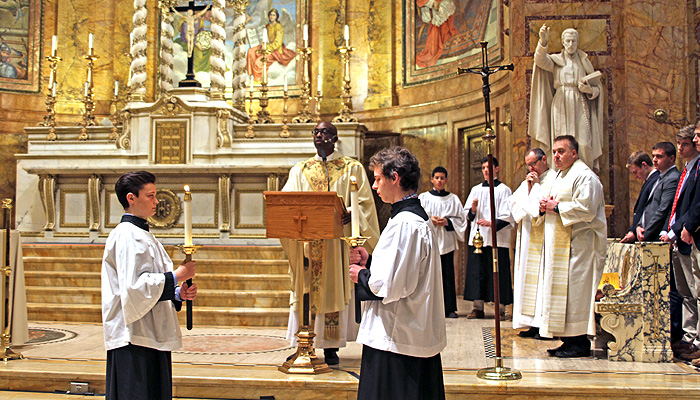
On Wednesday, November 23, the 麻豆视频 High School community gathered to celebrate the Thanksgiving Liturgy. Below is a reprint of Fr. Mario Powell's homily delivered at the Mass.
Padre, 驴Qu茅 paso anoche? 驴Estar茅 bien? 驴Mi hijo estar谩 bien?
These words, questions and fears are familiar to any mother raising a son. These in particular were the plaintive words spoken by a REACH Program mom to me the morning after the Presidential election. Will my son be okay? These were spoken by a woman, an undocumented immigrant, who crossed a border, and is raising her American son with worries and fears; hopes and dreams but doing so as an outsider.
The story from our gospel reading today of the one grateful Samaritan illustrates for us yet another image of whom and what matters to Jesus鈥攁nd thus what and whom should matter to us.
The story highlights two important themes in Luke:
1. Jesus鈥� care for the marginalized (here ten lepers and at least one of them doubly marginalized, a Samaritan)
2. The appropriate response to this care鈥攖hat of gratitude.
Jesus is on his way to Jerusalem, but before he gets there he passes through the region between Samaria and Galilee鈥攁 border. Jesus frequents these boundary areas; these areas where he is not supposed to go; these areas where he could potentially cross a social boundary. The boundary here was associating with lepers and a Samaritan.
Ten lepers approach Jesus as he enters the village, calling out to him but keeping their distance because they are unclean. They address him as master鈥攖he only other time this is uttered in the gospel it is uttered by the disciples. Here we have the unclean, the dirty, the filthy, the sick, the despised, the outsider, and the foreigners not only know who Jesus is, but their use of the term master equates them with the disciples. Jesus immediately sends them to show themselves to the priests to confirm their healing, and en route they are in fact made clean, following the pattern of the earlier cleansing of a leper at 5:12-14.
Cleansing of lepers is an identifying marker for Jesus鈥� mission. In the text for today, after the healing of the ten lepers, the focus narrows to one of the ten, who alone turns back glorifying God and prostrating himself at Jesus鈥� feet thanking him. This verb for thank is the one used when Jesus thanks God for the bread and cup at the last supper (22:17, 19; see also Paul in Acts 27:35). 鈥淔or I received from the Lord what I also delivered to you, that the Lord Jesus on the night when he was betrayed took bread, and when he had given thanks, he broke it, and said, "This is my body which is for you. Do this in remembrance of me". (1 Corinthians 11:23-24) It is the basis for our word Eucharist鈥攖o give thanks.
It is only after this man prostrates himself and gives thanks do we learn that the one who has turned back is a Samaritan.
Samaritans were the loved outsiders of Jesus鈥� day, and can we not think of who are the despised, the marginalized, and the unloved in our world, our community, our school, in our families? These people both in Jesus鈥� time were the very people Jesus would spend his time. The Samaritans were different and unwelcome outsiders鈥攖he very people received positively by Jesus in Luke. Jesus seems to keep pointing towards the outsider and commending them鈥攕pending time with them. In fact, he journeys to the margins in order to encounter the outsider and the despised. We see this elsewhere such as with the story of the Good Samaritan. It is not the respectable priest who demonstrates love for his neighbor, but it is this outsider, this marginal figure, yes, this Samaritan that shows love by showing mercy to a wounded stranger.
Jesus鈥� mission is the care for the marginalized, which our gospel highlights but there is also the rightness of our response which is also highlighted in the text:
1. 鈥淲ere there not ten made clean?鈥� Jesus asks. 鈥淏ut the other nine, where are they?鈥� Where鈥檚 their response?
2. 鈥淲as none of them found to return and give praise [literally give glory] to God except this foreigner?鈥�
3. And finally Jesus鈥� response to the Samaritan prostrate with thanksgiving at his feet: 鈥�. . . your faith has made you well [literally saved you].鈥�
To respond rightly to Jesus is to praise and glorify God.
The Samaritan鈥檚 act of prostration and thanksgiving; his recognition that God is at work when Jesus notices and heals hurts and brokenness that are not noticed by others; his understanding that to thank Jesus is to glorify God: this is the manifestation of faith that saves the Samaritan and makes him well. When the Samaritan recognizes Jesus as mercy and love鈥攈e is made whole. And this seems to come easiest to the people who have received most from Jesus, the ones who are otherwise ignored, scorned, and untouched. The act of thanksgiving and love that springs from gratitude is the essence of faith.
We do not know whether the other nine were Samaritans, but in identifying the Samaritan only after he alone is prostrate at Jesus鈥� feet, the narrator suggests that it is perhaps his having been noticed and cleansed in spite of his double-marginalization, his double experience of life at the edge, that creates his deeper gratitude.
There is no doubt something to be understood here about the people who live on the margins of our communities, who are treated as invisible or unlovely because of how they look or who they are or where they come from. Jesus clearly notices and loves them and calls us to do the same.
But we might also consider the parts of us that are hidden in the frontiers of ourselves where we may least want to be seen and most need to be touched. Jesus, who is not afraid of frontier, does not mind meeting us in those places, and it may be that by recognizing him there, we will find in our deepest selves a new outpouring of the grateful love that makes us well and whole.
Is this not the essence of Thanksgiving? That in the most vulnerable and in our most vulnerable we give thanks because it is precisely there that God-Jesus comes rushing in to make us whole and complete.
God will provide for all that we need鈥, come and sit at my table where saints and sinners are friends. I wait to welcome the lost and lonely to share the cup of my love鈥�
Thanks be to God.
Read more 麻豆视频 news