
The Owl Interviews Matthew Thomas '93, Author of Best-Selling Novel We Are Not Ourselves
The May 2015 Issue of The Owl, 麻豆视频 High School's student newspaper, published a student interview with Matthew Thomas '93, author of the best-selling novel We Are Not Ourselves. Below is a reprint of that interview.
by Britton O'Daly '16聽 |聽 Contributing Writer to The Owl
Without doubt, the 2014-2015 麻豆视频 School Year has been a great time for experiencing the literary works of 麻豆视频 graduates; especially recently, Matthew Thomas 鈥�93 and his book, We are Not Ourselves, have largely captured the attention of the 麻豆视频 community at large. Offering a great deal of insight into his own identity as both a writer and a 麻豆视频 graduate, Matthew Thomas 鈥�93 recently sat down with the Owl to share some words regarding his experiences.
The Owl: What do you most remember about your time at 麻豆视频?
Matthew Thomas '93: The classroom experience comes immediately to mind: how special it was to be in conversations every day that were so illuminating and that people took so seriously鈥攖eachers and students alike. There were conversations about literary texts that got into extraordinary sophistication and subtle readings, in which people were able to plumb the depths of works in a really extraordinary way. I always felt like I was getting an education not just from my teachers but from my classmates as well. The faculty took great care in doing their job, and it wasn鈥檛 just a matter of giving time; it was also a matter of giving spirit and energy. The term in Ignatian pedagogical speak is cura personalis鈥攖he care of the whole person. The faculty weren鈥檛 just listening with their ears but with their hearts and minds, and it felt amazing at that age to be embraced as a fellow human being and treated with respect by somebody you admired and respected a great deal. That was something that I remember standing out in my mind鈥攖hat sense of even though we all deferred to the faculty in a way that was almost to be intimidated by them, and in some cases, as in with Mr. Sabatelli, to be explicitly intimidated in a wonderful, fun way, we enjoyed that intimidation. Yet, there was also a sense of being respected as an intellect, and the conversation was often a two-way street, which which was wonderful.
The Owl: Were any teachers or experiences from your time at 麻豆视频 particularly inspiring for your writing?
Matthew Thomas '93: Oh sure! Mr. Vode was a mentor of mine, especially when I was a senior. He introduced me to a lot of Russian literature that I had not been exposed to before his class鈥攏ot just Tolstoy and Dostoyevsky (which I had been familiar with) but Pushkin and Turgenev. He was somebody who actually gave me writing prompts as assignments, so I remember writing fiction in an attempt to imitate the voice of Pushkin and Chekhov, and that was enormously useful. And Mr. Mullin, who is not there now, but was my English teacher my freshmen and junior year was a legendary figure as well. We had a particularly amazing time reading the romantic poetic tradition; he was just really great. He had studied at Oxford and was just terrific on English classical poetry鈥攖he conversations we had were some of the ones I alluded to earlier. In general, the writing I did at 麻豆视频 was instrumental in my development as a writer because we were just always writing鈥攅ssays especially. And the essays you would write for history class or theology class would have a literary or analytical component to them as well. There was a holistic quality to the liberal education we received, and I think it is no accident that 麻豆视频 has produced so many writers, especially recently.
The Owl: Would you say that coming into 麻豆视频 you were already interested in writing, or was it throughout 麻豆视频 that an interest truly developed?
Matthew Thomas '93: It was more throughout 麻豆视频. I had a kind of primordial sensation that I did want to write coming in, but it was really more that I enjoyed reading and that feeling I got in my chest as a reader of appreciation for the aesthetic experience of reading and the absorption in words and how they were put together. But I don鈥檛 know that I ever really thought of writing as a career or anything like that. I started doing some writing in my freshman year, writing poetry, and I wrote a good deal of poetry throughout my time at 麻豆视频鈥擨 only really started writing fiction towards the end of my time there. But it was a very fertile environment in which to write because there was a literary magazine鈥攚hich we called Images at the time鈥�
The Owl: Oh, Images is very much still around.
Matthew Thomas '93: I just remember that we would look forward to it coming out! Anticipating it was a lot of fun. I was on the editorial board my last two years there. I remember reading the stories of seniors as a freshman. There was a sense of it being published as if it were a real journal and we were waiting for it to come out. I鈥檓 not saying everyone in the school liked doing this, but I remember enough people would be very excited by the release of the publication and there was a sense of a kind of moment. So I thought in terms of the idea that people actually did read poems and short stories and that there may be actually an audience if you wanted to do this.
The Owl: Where there any other extra-curriculars you enjoyed at 麻豆视频?
Matthew Thomas '93: I wrote briefly for The Owl, which I enjoyed; I played baseball and did cross country and JV basketball. I did the Hearn, which I loved: I did DI and duo. So I did quite a lot of activities in my time there. I also did theater: I was in five total plays total that year, between 麻豆视频 and Brearley, so I was busy, very busy.
The Owl: What鈥檚 your favorite literary work?
Matthew Thomas '93: There are so many. I love The Great Gatsby because line for line it鈥檚 impeccable prose. It鈥檚 impossible to read that even thirty times and not feel moved by the prose style and the subtle way Fitzgerald enters into a fairly complex engagement with the ethos of American self-determination, renewal, and the idea of starting over again and how possible or impossible that is. This is something that is such an American theme and he deals in it very skillfully鈥攖he themes in this book, while sometimes obvious, are still subtly played out enough that they鈥檙e not thunderous. I also love Marquez鈥檚 One Hundred Years of Solitude and Love in the Time of Cholera because of the richness of the storytelling and the expansiveness of the characterization across the generations. The rich and full portrait of humanity you get in each individual and the way they relate to each other as family and friends is fun to behold because he gives you so much of a sweep of time. You watch people evolve over these generations, and you see how similar some of these generations are in his stories. The themes of one life are kind of repeated in the next generation, so I find it breathtaking to watch that achievement unfold鈥攊t is a panorama of human existence. Crime and Punishment is also one of my favorite books because of how insightful and emotionally moving the psychological portrait is: to watch this man fall into an extraordinary solitude of his own making and seem to be beyond redemption, and yet we watch him come out toward the light near the end. This is a book where whichever redemption there exists is earned because we spend the whole time in that book just watching this man come apart and despair in the deepest way. So Dostoyevsky is unstinting in his ability to go into darkness, and I guess when he gives you a little bit of light it feels like redemption for the reader as well.
The Owl: You brought up an admiration for a theme of generations and exploring that human expanse; was that inspirational for We are not Ourselves?
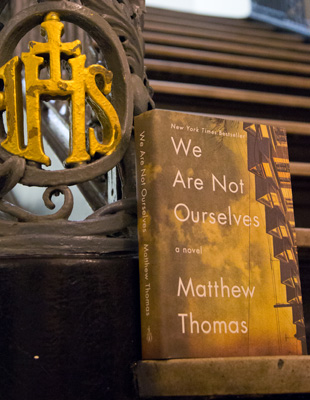 Matthew Thomas '93: Yes, definitely. I wanted to write a book that would take on a lot鈥攚ork on a large canvas. And I had models for that from the books I mentioned in addition to Dickens, Tolstoy, and others. There are just a lot of examples one can choose from. But yeah, when I eventually figured out that this book could bear the weight of an inter-generational story and go beyond the immediacy of this family鈥檚 lives, I decided that it would be fun getting it right on a big canvas like that.
The Owl: At one point in the ten years of writing We Are Not Ourselves did you overcome that hurdle of fearing failure, or did that come before you started the novel?
Matthew Thomas '93: Oh God no鈥擨 was in the murk for a long time writing this book. Maybe halfway through I started feeling that I was writing something that was worth someone鈥檚 time. And maybe that was because of how much I had put in鈥擨 just acquired more skills over time. There emerged a greater fluency and a greater ease of composition; after enough time had passed, maybe it was a more rapid composition. Going back to the original question, however, I would definitely say at least halfway through. I mean, going into the first five years of writing this book I had already gone through two grad programs and I had lived the life of the writer in a sense already at that point. When I started this book I was 27, and I felt confident at the beginning. What I鈥檓 saying, and I hope this can serve as a lesson, is that I felt that I knew what I was doing in the beginning, when really five years later was when I knew that I knew what I was doing. But truly, until the end you never really know. How it will be received by anybody is a mystery in some ways鈥擨 wasn鈥檛 showing the book to anybody, which was part of it. I was working on it on my own. So yeah, it鈥檚 a life of constant, implicit doubt.
The Owl: At one point did you decide you should include 麻豆视频 in your novel?
Matthew Thomas '93: I decided to put 麻豆视频 in after I had tried a number of ways to exclude 麻豆视频 in the interest of avoiding anything that smacked of autobiography. I had Connell going to a number of schools, invented and otherwise. But I decided to use 麻豆视频 in the book when it struck me that 麻豆视频 would have a particular resonance for this family, for this woman Eileen in particular. The environment 麻豆视频 provides, I realized, would in fact yield opportunities thematically for Connell鈥攐pportunities for extraordinary growth and extraordinary transformation in his life within that frame of time. So he starts in sports and he winds up doing debate, and while it鈥檚 possible that that can happen anywhere, the lure of debate and the lure of the transformative power of a life like that would鈥檝e been more relevant at a place like 麻豆视频 than some other school. But I think I mostly realized that if there was not a 麻豆视频 to write about, I would鈥檝e wanted to invent a school like 麻豆视频 for this novel鈥攖hat鈥檚 exactly the kind of school Eileen would be desperate for her son to go to.
The Owl: Do you have any advice for aspiring writers at 麻豆视频 right now?
Matthew Thomas '93: Yeah鈥攚ork as hard as you can and forgive yourself when you鈥檙e not either working as much as you think you should or producing work that you think is worth showing anybody. It鈥檚 a hard life in the first place and as productive as it can be to censure oneself and as useful as it sometimes can be to feel bad about things like a lack of productivity, it can also be damaging because there may be a reason you aren鈥檛 writing much at a certain time. Maybe you鈥檙e soaking up some of life, reading more, internalizing unconsciously the rhythms of the language, or learning about human beings and understanding people as characters鈥攖here may just be a reason it鈥檚 not happening at that moment. And I think that if one chooses that life there is so much failure, difficulty, and seemingly fruitless striving implicit in it that the kinder one can be to oneself at any point in the process the better. Also, I would say the most important thing is to not look at one鈥檚 first draft as the final draft鈥攏ot to be so discouraged by what you see when something is in its nascency as it鈥檚 not, in fact, proof of anything. It鈥檚 not proof of one鈥檚 inability to ever do it for it not to be done yet. This is crucial because everybody鈥檚 first drafts are really terrible鈥攅ven when they鈥檙e not, they are. With writing in particular, with something like writing where there isn鈥檛 a task set out for one like the law, or something like that. You know, often people feel diabolical in making the decision to be a writer: family members may not support the idea and the culture at large seems to think it鈥檚 a waste of time. When you have these obstacles, you can start to get into these existential inquiry, such as 鈥渁m I a writer,鈥� 鈥渟hould I be doing this,鈥� 鈥渁m I lying to myself,鈥� and when you鈥檙e in that kind of mindset any proof of that can become really damaging psychologically, especially at an early age. There are so many reasons not to write鈥攊f you have a real inclination to write there has to be a kind of self-protection. And part of that comes in just realizing that for years the work will not be very good. For years, the work will be at times embarrassing. But if the work gets done, and if it gets done enough, you sweat out all that really bad writing you have to do. But if you look at that bad writing and you say that this is who you are as a writer, what鈥檚 going to happen is, unless you have an iron constitution, you may just stop. I just think that there has to be an openness to failure, and to failure as the opposite of proof.
Read more 麻豆视频 news